Hardwood Floor Refinishing
Sanding and refinishing for wide-plank white oak, or a lighter recoat when only the factory finish has worn.

Milton, GA · Fulton County
Milton, GA hardwood refinishing & installation for equestrian estates and custom homes near Crabapple. 10,000 jobs completed in Georgia. Call 470-826-3581.
Milton is horse country that grew custom-home neighborhoods around it, and the flooring here reflects both halves of that. Out toward Freemanville, Birmingham Highway, and the Crabapple side of town, lots run one to five acres, with board-and-batten farmhouses and outbuildings as common as three-car garages. Most of what we see is younger than the flooring stock in older parts of metro Atlanta, built from the early 2000s through the last few years, so it is usually solid or engineered white oak in wide planks rather than narrow-strip oak from a 1960s subdivision. The issues here have less to do with age and more to do with scale. Great rooms can run 700 to 800 square feet with open sightlines into the kitchen, additions need to match an existing floor that has already sun-faded near the big windows Milton builders favor, and builder-grade factory finishes on a custom home were never built to survive a decade of daily traffic from kids, dogs, and barn boots.
Call 470-826-3581 or request a free estimate online. We serve Milton and all of Fulton County, and we’re open 24/7.
A member of The Hardwood Guys team will call or text you to schedule your free on-site estimate. We schedule 24/7.
Sanding and refinishing for wide-plank white oak, or a lighter recoat when only the factory finish has worn.
Solid and engineered hardwood for new rooms and additions, matched to the old floor after a subfloor and moisture check.
Waterproof-rated vinyl plank, including COREtec and NuCore, for kitchens, baths and basements, and AquaGuard laminate for kitchens and finished basements.
Board replacement and spot repair, including worn mudroom and back-hall floors, blended into the floor around them.
Deep cleaning, and a screen and recoat between refinishes, to renew a finish before it wears through.
Natural-look hardwax oils, Rubio Monocoat among them, for a low-sheen finish that leaves the grain showing.
Before we refinish a Milton floor, we look at what it is made of and how much wood is left to sand. That tells us how far the work can go and which finish suits the room. Our hardwood floor refinishing page covers the full process.
Solid hardwood can be sanded more than once over its life. Engineered boards are a layer of real wood on top of a plywood core, so the question is how much of that top layer is left. We measure it before the sander comes out, because a floor that has already been sanded thin may not take another full pass. If that is the case, we tell you plainly and go over what else can be done. Our FAQ on whether wide-plank white oak is solid or engineered explains what we check.
A full sand takes the floor down to bare wood. That is the route when you want a different color, when scratches or stains have gone into the wood, or when the finish has worn through. A screen and recoat is lighter work. It scuffs the old finish and puts a new coat over it, which suits a floor that looks tired but is still in good shape and has a color you like. We decide between the two on site, once we have seen the floor.
In our Milton video, a floor that had been sanded unevenly was fully resanded, given a natural seal, and finished with coats of Bona HD Traffic. The same video says we also refinish stairs, treads and rails to match, so a staircase can be part of the same job. Video posted December 2025. You can watch it under Watch Our Work.
What goes under the new floor decides what we can put on top of it. Over a wood subfloor, we check moisture, level and any squeaks before the first board goes down. Over a concrete slab, we test moisture first, because solid hardwood generally should not be fastened straight to concrete. Our hardwood floor installation page covers the full process.
Solid hardwood is nailed down over a wood subfloor. Engineered hardwood is glued down or floated, which is why it is often used over a slab. Our engineered hardwood page shows how the two compare.
When new wood has to meet old, we match species and grade first, then lace the new boards into the existing floor so there is no straight seam. Stain is adjusted after that. If you are adding a room or an addition, tell us early so we can plan the match. Our FAQ on matching new white oak to older flooring covers how we blend the seam.
Neither of these jobs was in Milton. They are nearby examples of how we handle installs.
Nearby example, Roswell (video posted March 2025): we removed old tile mud beds and hardwood that had been installed incorrectly over particle board. New plywood and sleepers leveled the subfloor, and we installed white oak select grade planks, stained Provincial and finished with oil-based polyurethane. More on hardwood flooring in Roswell.
Nearby example, Alpharetta (video posted September 2024): we installed new hardwood in a bedroom, matching the grade and type to the existing wood, and finished the floors, handrails and stairs. More on hardwood flooring in Alpharetta.
Many Milton floors are wide-plank white oak, and much of what we open up is engineered, a real-wood top layer over a plywood core. After a leak, that construction decides a lot. Our water-damaged hardwood floor repair page covers the full process; this is what it means for a Milton home.
Cupped, crowned and buckled boards mean different things, and we read the moisture in the boards and the subfloor before deciding what to do. Cupped boards often settle once the wood and the subfloor return to normal moisture, which can take weeks, not days, so we do not rush to the sander. Wide-plank engineered floors are common over a slab or a crawlspace with a moisture concern, so we check what is under the floor as well as what is on it. On an engineered floor we also measure what is left of the top layer. Engineered boards can be replaced one at a time, but a prefinished floor can only be sanded to blend if its wear layer allows it, so matching the exact product matters more.
If the damage is in one area, we cut out the bad boards and work new ones into the existing floor, matching species and width so there is no straight seam. In a great room that opens to the kitchen, we plan the sand and finish so the repaired boards blend into the rooms around them instead of stopping at a doorway. Where a wide-plank floor still wears its original factory finish, the repaired area is refinished with the surrounding floor so the repair does not show as a patch. When the wear layer or the core cannot take another sand, replacing is the honest answer, and we say so. Do not run a rental sander on cupped boards hoping they flatten.
Here is a recent water-damage repair on video: new #1 grade red oak was laced in to match the floor that was already there, plywood subflooring went in over the concrete areas, and the finish was a Weathered Oak stain under Bona HD Traffic.
Photos and moisture readings go into a written estimate, so you have a plain record of what was wet and what the repair covers. Tell us which rooms got wet and how long ago, and text photos of the damage if you can. We document and repair. Your homeowner's policy decides coverage. We respond to calls and texts the same business day.
We are based in Woodstock, and Milton is a straightforward run down GA-400 or across on GA-9 and Freemanville, close enough that a crew showing up for a walkthrough is not losing half a day to the drive. That matters more in Milton than it sounds, because these are big jobs: five-bedroom homes with three finished levels take real scheduling, and a family-run crew that is not juggling a dozen subcontractors can hold a start date. We bring 25 years of experience and 10,000 jobs completed in Georgia, and we have worked in enough Crabapple-area homes to know what a custom builder's factory finish looks like ten years in, and what a horse property's mud and grit does to a mudroom floor. Reviews are written by real customers. Milton borders Alpharetta, and we work there too; see our page on hardwood flooring in Alpharetta. We also work in nearby Roswell; see hardwood flooring in Roswell.

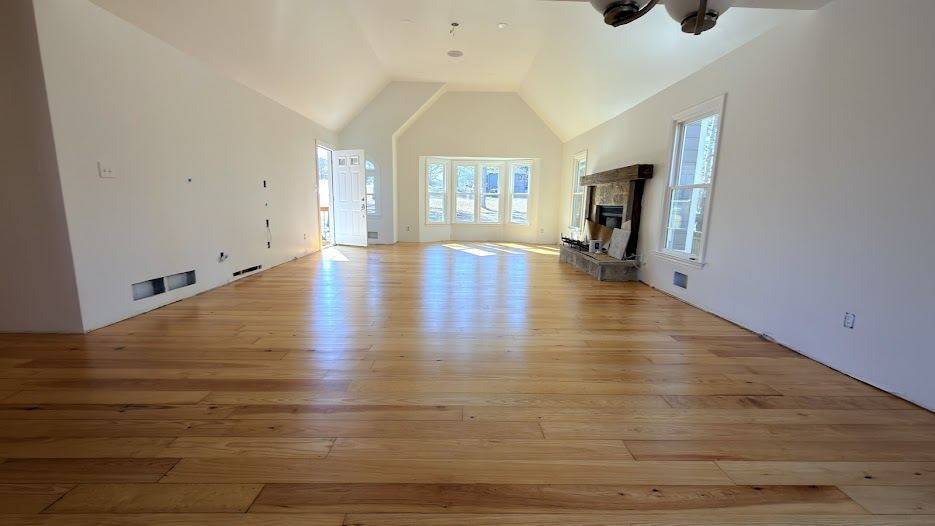
If your Milton home is a custom build from somewhere between 2003 and 2015, the great room, kitchen, dining room, and formal entry are often wide-plank white oak that has lost its shine under the original factory finish, and we plan the refinish for the whole first floor so the rooms match. If you are replacing carpet in a home office or bonus room over the garage, we match the new hardwood to the existing floor down the hall. On the larger equestrian lots, boots, dog claws, and barn dust can wear through the finish in the mudroom and back hall faster than in the rest of the house, even when the wood itself is only a decade or so old, and we can repair those areas.
Real jobs filmed on site. We have posted over 160 of these to YouTube.
Cupped or buckled floors after a leak? We repair, replace and refinish matching boards and document the damage. Your homeowner's policy decides coverage. See water-damaged hardwood floor repair.
Mostly it changes what we plan for at the mudroom and back door, not the refinish itself. Barn dust, hay chaff, and grit track in more than a typical Milton subdivision, so we pay extra attention to those transition areas and often recommend a tougher finish like Bona Traffic HD there even if the rest of the house gets something softer.
In Milton's newer neighborhoods, most of what we open up is engineered, a real wood wear layer over a plywood core, which is standard for wide-plank floors on a slab or over a crawlspace with any moisture concern. It refinishes just like solid wood as long as the wear layer has not already been sanded thin, which we check before we start.
That's typical for homes built during the early-to-mid 2000s Milton boom. Builder-grade finish on wide-plank white oak wears through in high-traffic sightlines, the kitchen island, the family room path to the patio doors, well before the rest of the floor shows it. It is not a sign of a bad floor, just a factory finish reaching the end of its life.
Yes, though it takes more than picking the same species. Sun exposure through Milton's big windows ambers white oak over time, so we sand and blend the seam between old and new, and adjust the stain on the new boards to land close to where the existing floor has aged rather than matching it straight out of the box.
No, refinishing existing hardwood does not trigger a Fulton County permit, since you are not changing the structure or footprint. New installation over a different subfloor, or work tied to a larger renovation, sometimes does, and we will flag that during the walkthrough if it applies to your project.
Yes, we take on detached spaces regularly in Milton, where guest houses and barn apartments are common. They are usually quicker jobs than a main house, but we handle scheduling, dust containment, and finish selection the same way we would for the primary residence, so the two floors still end up looking consistent.
Often only the damaged planks go. Engineered boards can be replaced one at a time when we can match the product, and the repaired area is sanded and finished with the floor around it if the wear layer allows another sand. If the wear layer or the core cannot take another sand, replacing is the honest answer. We check before we promise either.
No. Sanding cupped boards before they are dry swaps cupping now for crowning later. We take moisture readings on the boards and the subfloor first, then decide between waiting, sanding and replacing.
It depends on what the water reached. On the recent repair shown on this page, the work included new plywood subflooring where the floor sat over concrete, porcelain tile in the laundry room, and paint and drywall repairs around the affected areas. When the drying is a bigger job than the flooring, we coordinate with a mitigation company.
Free estimates, scheduled 24/7. We will come out, look at the actual floor, and tell you what it needs.