
Woodstock, GA · Serving North Metro Atlanta
Hardwood, Engineered & LVP/Laminate Floor Repair in Woodstock & North Metro Atlanta
Water damage, worn boards, pet stains, peeling veneer or hollow spots: we repair the floor you have, matched to it, and tell you honestly when refinishing or replacing makes more sense.
- 10,000 jobs completed in Georgia
- 25 Years of Experience
- Insured & Family Owned
- Warranty1-year warranty from completion
- FinancingUp to $100,000, subject to approval
- Response timeSame business day · scheduling 24/7
- Experience10,000 jobs completed in Georgia · 25 years of experience
- Family-runFamily-run, owned by David Brannan
Water damage? Start here
If a leak, burst pipe or flood has left your floor cupped, buckled, gapped or stained, start with water-damaged hardwood floor repair. Water damage is handled in a different order than a scratch or a loose board.
Water-damaged hardwood floor repair
We meet with you, and with your adjuster on site if needed. Your policy decides what is covered. We document the damage and repair the floor.
The source of the water has to be found and fixed first, and the floor needs time to dry.
Board replacement and lacing-in
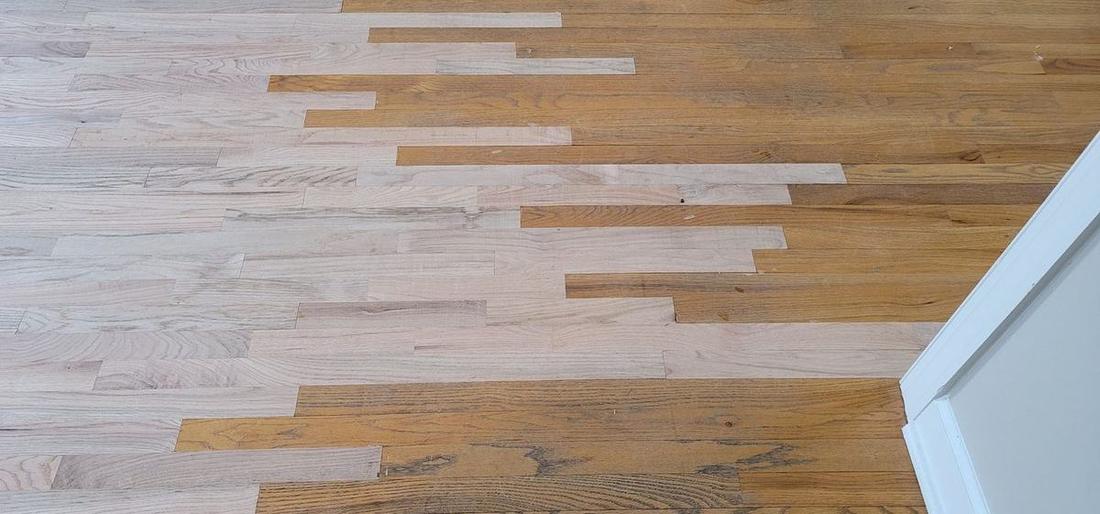
When boards are too damaged to fill or sand out, we replace them. Lacing-in means removing the damaged boards and weaving new ones into the surrounding rows, so the joints and grain line up with the rest of the floor.
Whether it shows comes down to the match: species, width and grade, then stain and finish (see matching species, width and stain below). On a solid floor, the area is then sanded and finished so old and new read as one surface.
Replacement is usually the right call for:
- Deep gouges that filler will only hide
- Boards stained through by pet urine, a planter or an appliance leak
- Boards cupped or buckled by water beyond flattening
Prefinished floors are hard to blend by sanding, so the repair depends on having more of the exact same boards. We ask that matching boards be on site for the replacement, so keep any leftover boxes from your install.
In this water-damage job, we laced in new #1 grade red oak to match the existing floors and replaced only the areas the water reached. Over concrete, we installed new plywood subflooring to support the new planks.
Subfloor and plywood problems
A hardwood floor is only as good as what it is fastened to. Soft spots, boards that move or squeak in one area, or a floor that is out of flat often point below the surface.
Common causes are damaged or delaminating plywood, particle board underlayment, and old material left in place, like tile mud beds. Boards laid over a bad subfloor fail the same way again, so we look at what is underneath first. Fixes range from re-fastening loose plywood to replacing panels or adding sleepers, which are strips of lumber that build a flat base to fasten to.
This Roswell, GA job is one example. We removed old tile mud beds and hardwoods that had been installed incorrectly over particle board, added new plywood and sleepers to level the subfloor, and installed select grade white oak planks with provincial stain and oil-based polyurethane. We also repaired some poor kitchen fixes.
Squeaks and gaps
A squeak is usually a board rubbing its neighbor or working loose from the subfloor. Sometimes a screw through the board into the subfloor, with the hole filled in a matching color, solves it. Our post on how to remove squeaks from hardwood floors shows one do-it-yourself method. Squeaks across a whole room usually mean a subfloor problem.
Gaps are mostly about humidity. Wood shrinks in the dry winter months, especially near fireplaces and heating vents, or over a basement or garage that is not conditioned like the rest of the house. Some seasonal movement is normal. Small gaps can be filled with wood filler or color putty. Gaps that keep widening, or come with cupping or dampness, deserve a closer look. Our guide to common repairs needed for hardwood floors has more.
Pet damage, scratches and stains
Pet urine soaks into wood, leaving dark stains and odor and breaking down the finish. Shallow staining can be sanded, treated with wood bleach and refinished. Once it has soaked deep, the damaged boards have to come out.
Scratches depend on depth. Minor ones can often be touched up or colored in. Finish-only damage can be spot-sanded and recoated, though a sheen or age difference may leave the patch visible. A deeply gouged board is fixed only by replacing it.
In this Alpharetta, GA job, we removed pet-damaged red oak and laminate across more than 300 square feet, made repairs, and refinished the floors in the light, natural look the customer wanted. The older home’s floors came out flat.
Stair repairs and full stair renovations
Stairs take the hardest wear in a house. Loose or squeaking treads, worn or cracked treads, damaged nosings and cracked risers can often be repaired or replaced one part at a time, then stained and finished to match the steps around them.
When a staircase needs more than a repair, we do full stair renovations: new treads and risers, and new box newels, rails, posts and spindles in iron or white. On a Roswell job, for example, we replaced the staircase with new box newels and square white balusters as part of a whole-floor rebuild. For parts to match your floor, see our red oak stair parts and white oak stair parts.
Engineered hardwood repairs
Engineered hardwood is a real wood veneer bonded to a plywood or composite core. The top layer is thin, so repairs work differently than on solid hardwood.
Peeling veneer usually shows up at seams, in high-moisture areas, or where the adhesive has aged and failed. Once veneer separates from its core, that spot cannot be sanded flat, because sanding through the thin wear layer exposes the core. Our post on why engineered wood veneers peel explains more.
Before replacing anything, we look for the cause. Peeling near a wall, appliance or entry points to moisture, and new planks over a moisture source fail the same way.
A small area may be fixed by replacing the affected planks. If peeling covers more, replacing a section or the whole floor is usually more practical than repair. We assess veneer thickness and condition on site, so you are not paying for a repair that will not hold.
LVP and laminate repairs
LVP and laminate flooring are usually floating floors: planks click together and rest on the subfloor instead of being glued down.
Hollow spots. A slight hollow sound in a few places can be normal click-lock give. A pronounced hollow or spongy feel in one area usually points to an uneven subfloor, a gap in the underlayment, or planks that never locked together. Spots spreading across a room mean the subfloor needs leveling before the planks are relaid. See how to fix hollow spots in LVP flooring.
Lifted or swollen planks. Planks that peak or swell at the seams often trace back to moisture from below, or too little expansion room at the walls. Laminate typically has a fiberboard core, and a swollen plank generally cannot be dried back into shape, so it is replaced. The moisture source gets fixed first.
Plank replacement. Replacing one plank in the middle of a floating floor usually means unlocking rows back from the nearest wall, or cutting the damaged plank out and fitting a new one. If the exact plank is no longer made, it is better to learn that before work starts.
Matching species, width and stain
A repair only disappears if the new boards match, and that takes more than the same stain name.
- Species. Red oak and white oak have different undertones and take stain differently.
- Width. Even a slightly different width shows in the joints.
- Grade. Mill oak now runs more rustic, and some No. 1 grade looks like No. 2 from years ago. We sometimes mix grades for a better match.
- Age. Older floors darken, and new boards start out lighter.
- Finish. A natural, unstained finish is the hardest to match.
We test the stain on a sample of the actual new wood before a full lacing-in job, and can show you the color on a sample of your floor’s own species and grade. Browse real samples in our stain color chart.
The first video is an Atlanta, GA job. Other contractors had told the homeowner the floors were maple or hickory. We identified custom-milled rift and quartered white oak, special-ordered it (four weeks to arrive), and the new planks matched. The second shows new red oak laced into existing red oak, where the grade note above comes from.
Repair, refinish or replace: how we decide
Not every damaged floor needs a repair. Here is how the three usually line up.
| Option | Usually fits when | What it involves |
|---|---|---|
| Repair | Damage is limited to a few boards or one area, the boards can be matched, and the subfloor is sound. | Board replacement or lacing-in, fills and touch-up, then blending and finishing. |
| Refinish | Damage is shallow but widespread: many scratches, worn finish, uneven color. | Sanding to bare wood and new finish. For finish-only wear, a screen and recoat may be enough. |
| Replace | Large areas are cupped, buckled or badly stained, boards cannot be matched, or the subfloor is failing. | Removing the affected flooring, correcting the subfloor, and installing new flooring. |
Extent. One damaged spot points to repair. Damage spread through a room can favor refinishing or replacement.
Board availability. Solid hardwood can be sourced or milled to match. For prefinished and engineered floors, whether the exact product is still made decides how much can be repaired.
Subfloor condition. If it is soft, wet or uneven, it gets fixed first, or the repair fails.
After a repair, we usually recommend hardwood floor refinishing across the area, because finishing the whole surface makes old and new read as one floor. For finish-only wear, a screen and recoat may be enough. We will tell you honestly which situation you are in. The hardwood floor cost guide explains what affects repair cost. We repair floors across Woodstock and North Metro Atlanta; see our work in the project gallery.
Frequently Asked Questions
Can a damaged hardwood board be replaced without it showing?
Often, yes. New boards in the same species and width are woven into the existing rows, then stained and finished to blend. How well it blends depends on species, grade, the age of the floor and the finish. We test the stain on the new wood first.
Does water damage mean I need a whole new floor?
Not necessarily. It depends on how far the water spread and the condition of the subfloor. Localized damage may only need the affected boards replaced, while widespread cupping or buckling may call for more. The source has to be fixed first, and your policy decides coverage.
Can you fix deep scratches and pet stains without refinishing the whole room?
Sometimes. Minor scratches can be touched up, and finish-only damage can be spot-sanded and recoated, though a sheen difference may remain. Deep gouges and urine that has soaked in usually mean replacing the boards. If damage is widespread, a full refinish is often the better result.
Can peeling veneer on engineered hardwood be repaired?
For a small area, replacing the affected planks may be practical. Once veneer separates from the core, it cannot be sanded flat, so if peeling covers more than a small area, replacing a section or the whole floor is usually more practical. We check for a moisture source first.
Why does my LVP or laminate floor feel hollow or lift at the seams?
A slight hollow sound can be normal click-lock give. A pronounced hollow area usually points to an uneven subfloor, an underlayment gap, or planks that never locked. Lifting or swelling at the seams often traces to moisture or too little expansion room. An on-site look is the reliable way to tell.
How do you decide between repair, refinishing and replacement?
Three things: the extent of the damage, whether matching boards are available, and the condition of the subfloor. One area with a sound subfloor points to repair, shallow widespread wear to refinishing, and large damaged areas or a failing subfloor to replacement. We will tell you honestly which fits.
Request a Free Estimate
Tell us about your project and we'll get back to you with an estimate — usually the same business day.
Thanks — We'll Be In Touch
A member of The Hardwood Guys team will call or text you to schedule your free on-site estimate. We schedule 24/7.